
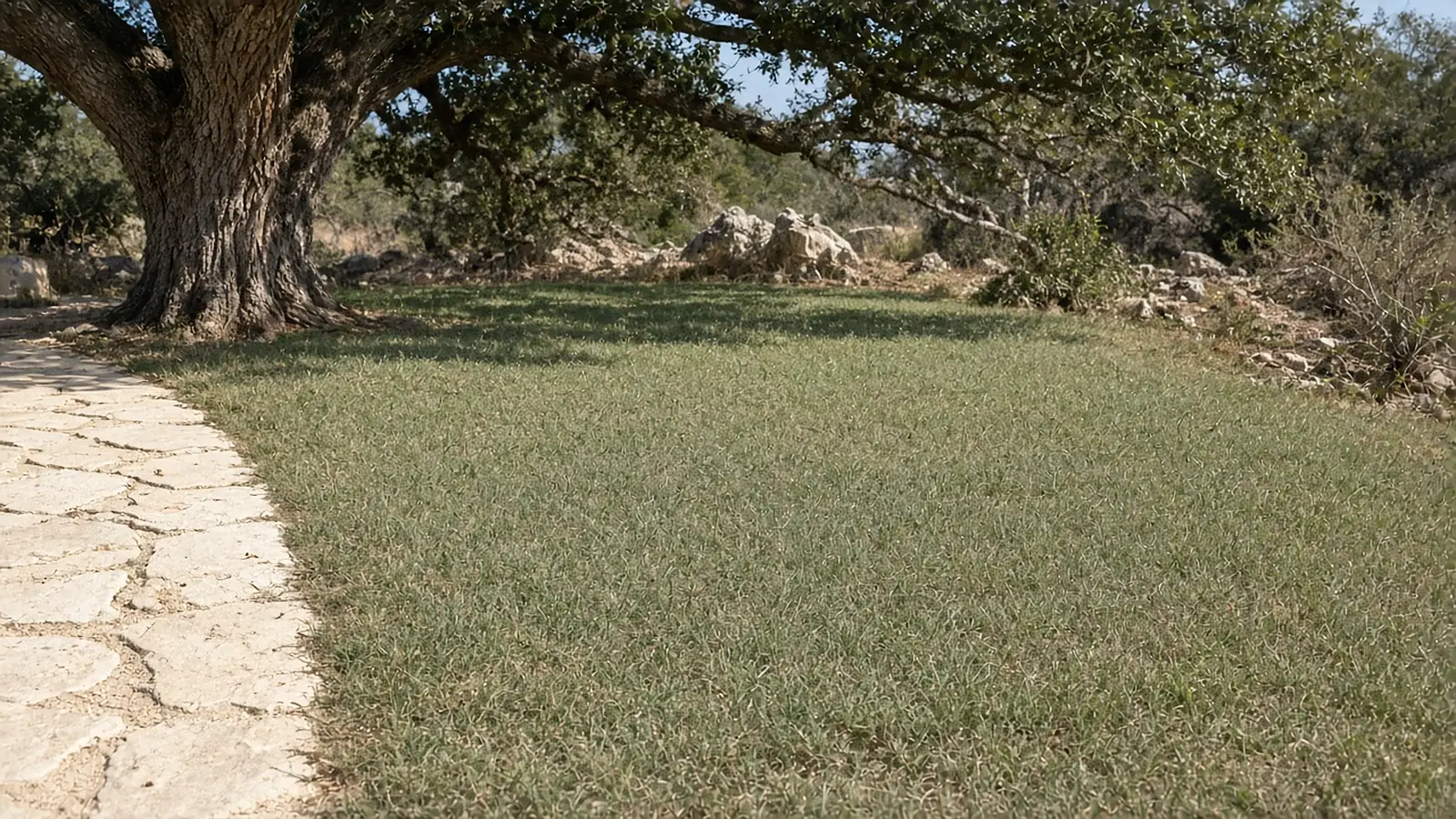
Buffalo grass lawns in the Hill Country
Buffalo grass (also written buffalograss) is a native, warm-season turfgrass that many Hill Country households look at when a thirsty lawn and a tight watering schedule stop making sense. This guide is written from a buffalo grass lawn in ZIP 78133, Canyon Lake, Comal County. It covers what Texas A&M AgriLife Extension and the Lady Bird Johnson Wildflower Center have published about planting it from seed, plugs, or sod — and what they say about soil, sun, watering, mowing, and weeds. It does not invent varieties, rates, or dates that those sources do not give.
What buffalo grass is
The Wildflower Center’s native plant database describes buffalograss (Bouteloua dactyloides) as a soft, gray-green or blue-green perennial turf grass that grows 3–12 inches if left unmowed and spreads by rhizomes. It is a long-lived, warm-season, sod-forming grass, and the Center calls it one of very few drought-tolerant North American grasses suitable for lawn use, and the only one widely available. Two other drought-tolerant native lawn grasses named on that same page are blue grama (Bouteloua gracilis) and curly mesquite grass (Hilaria belangeri). [1]
AgriLife treats buffalograss as a warm-season turfgrass that can be established from seed, sod, or plugs (sprigs are listed as not recommended). Many improved types of buffalograss, AgriLife notes, do not produce viable seed and are available only as sod, plugs, or sprigs. [2]
Is it a fit for a Hill Country yard?
AgriLife’s turfgrass-selection publication says buffalograss is best adapted for areas with an annual rainfall of 25 inches or less; when it is planted in the high-rainfall areas of East Texas — or when it is watered excessively — it is easily invaded by weeds and other grasses. It does best in full sun and has little tolerance of shade, and AgriLife says it does well as a low-maintenance lawn grass from Central to West Texas. [3]
The Wildflower Center lists light requirement as sun, water use as low or medium, drought tolerance as high, and calcium-carbonate tolerance as high. Its soil description is well-drained loam, clay, caliche, or limestone; the profile states that buffalograss “does not like sand.” The Center says it does best in clay loam, where it can survive on as little as one and a half inches of rainfall per month, and that it will go dormant during droughts and in winter. A conditions comment on the same page says it requires only one and a half inches of rain per month to stay green. [1]
A Wildflower Center Q&A about native turf in the San Antonio area makes a related light requirement explicit: buffalograss, blue grama, and curly mesquite “won’t do well unless your site has at least 6 hours of sunshine per day.” [4]
Those sources do not publish a Canyon Lake or Comal County annual-rainfall number here, so this guide does not invent one. What they do say, and what matters in a restricted-water Hill Country yard, is that full sun, well-drained non-sandy soil, and not overwatering are the conditions AgriLife and the Wildflower Center associate with a successful stand.
AgriLife lists sod cultivars available in Texas as 609, Density, and Prairie, and seeded cultivars as Bowie, Cody, Common, Texoka, Commanche, Plains, and Topgun. [3] The Wildflower Center names Texoka and Comanche as forage types that can reach 12 inches, and Prairie, 609, and Stampede as lawn selections, with Stampede described as not getting taller than 4 inches. [1] Variety names and spellings are reproduced as each source printed them.
Seed, plugs, or sod
| Method | How AgriLife describes planting it | Quantity per 1,000 sq ft | Best planting season in that table |
|---|---|---|---|
| Seed | Broadcast | 2 to 3 pounds | Spring |
| Plugs | 2-inch sod plugs on 12-inch centers | Cut sod pieces from 30 square feet of sod | Spring and early summer |
| Sod | Solid planting staggered in a brick-like pattern | The same amount in square feet as the area to be sodded | Listed as “same as above” |
AgriLife says seeding costs less than other planting methods, but that sodding may not cost more than seeding when the long-term cost of “growing in” seeded turf is considered, and that seed usually requires more irrigation. Sod also gives immediate soil-erosion control. Many improved grasses do not produce viable seed and are only available as sod, plugs, or sprigs; seeded types are typically not commercially available as sod. [2] This guide does not invent prices.
The Wildflower Center’s Q&A writers have said sod can be planted any time of the year and is more expensive, and that it gives faster coverage. [5] [6] That “any time of year” wording is from those expert answers, not from AgriLife’s Table 2, which lists buffalo grass sod as “same as above” after the plug season (spring and early summer). This guide leaves both statements in place rather than collapsing them into one rule.
AgriLife also says most sod producers do not market plugs, and that plugs can be cut from sod pieces or taken from healthy turf, with the holes backfilled. Plugs must be firmly pressed into the soil and then rolled. [2]
When to plant
AgriLife says warm-season grass seed germinates best when the temperature is 70°F to 95°F, so late spring to early summer is the best time to seed bermudagrass and other warm-season turfgrasses, allowing them to become well established before the growing season ends. [2] That sentence says “the temperature.” It does not say “soil temperature,” so this guide does not treat 70–95°F as a soil-thermometer rule.
The Wildflower Center profile says to sow treated seed from April to September, preferably in clay loam; if on caliche, sow thickly; keep moist until established. It also says seed requires light for germination, that old seed germinates better than young seed, and that seeds should be cold-moist stratified at 40 degrees for six weeks. [1]
Planting into a drought stage is a separate problem from the horticultural calendar. See Watering natives under local drought rules for current local schedules and for Texas Water Company’s published notice that variance requests for new sod or landscaping will not be approved in Stages 2–4.
Soil, sun, and site prep
AgriLife’s establishment publication tells readers to test the soil before planting. It says Texas soils are often deficient in major nutrients, that a soil-test report will say how much fertilizer to apply before planting, and that fertilizer should be tilled into the upper 4 to 6 inches of the soil. Sample boxes and analyses are available through county AgriLife offices, or samples may be sent to Extension’s Soil, Water and Forage Testing Laboratory. AgriLife says to allow 2 to 4 weeks for results. The publication also says turfgrasses are healthier, need less water, and tolerate stress better in a deep, non-compacted soil, and that a soil depth of 10 to 12 inches is preferred. [2]
A Wildflower Center expert answer that quotes the Center’s “Native Lawns: Buffalograss” how-to article gives these bed-preparation steps for seed and sod: till the soil no deeper than two inches; rake level, and roll the soil lightly to make the bed firm; remove all existing weeds; because tilling often stimulates weed germination, water the bed one to two weeks before planting. [7]
Those two sources are not identical on tillage depth (AgriLife’s pre-plant fertilizer is tilled 4 to 6 inches; the Wildflower Center how-to, as quoted, says till no deeper than two inches). This guide reports both rather than inventing a single depth.
How to plant
Seed
Broadcast at the AgriLife rate of 2 to 3 pounds per 1,000 square feet, in spring. [2] After seeding, AgriLife says to roll so the seed will have good contact with the soil. [2] The Wildflower Center adds that seed requires light for germination, so it should not be buried in a way that contradicts that note, and that treated seed should be kept moist until established. [1]
AgriLife warns that mulching is a common practice on cool-season grasses but not on seeded warm-season grasses such as bermudagrass or buffalograss, “since heavy mulch blocks out sunlight needed for warm-season grass seed to germinate.” Hydro-seeding may include a layer of hydro-mulch; that is a different method. [2]
Newly seeded turf, AgriLife says, should be watered frequently. The first few weeks are especially critical; if young plants dry out, they may die. Keep the seed and the soil moist, not saturated. It may be necessary to water four or five times for short periods on hot, windy days. After about two weeks, seedlings should be growing (germination time varies with species), and watering can be adjusted as they mature. [2]
That establishment watering has to fit inside whatever schedule your utility is currently enforcing. If the current stage does not allow frequent watering, or does not grant a new-lawn variance, the horticultural advice and the legal schedule may not line up. That is a reason to read the watering-rules article before you plant, not after.
Plugs
Use 2-inch sod plugs on 12-inch centers, in spring and early summer, cutting pieces from 30 square feet of sod per 1,000 square feet to be planted. Press plugs firmly into the soil and roll. [2]
Sod
Plant solid sod in a brick-like, staggered pattern, using the same area of sod as the area being covered. Butt pieces tightly together. Immediately after planting, roll with a weighted roller. Keep the sod moist until it is well-rooted; if it dries soon after transplanting, AgriLife says it will tend to shrink and separate, leaving gaps where weeds can grow. After planting sod, water enough that the soil under the sod is wet to a depth of 2 or 3 inches. Avoid overwatering, because roots do not grow as quickly in saturated, oxygen-deficient soil. Water newly sodded areas as you would established turf, except more frequently: each time the sod begins to dry out, water to a depth just beyond the (drying) sod. [2]
AgriLife’s “fully established turf” section says it is often assumed a lawn is established when it covers the ground, but grass from seed or sprigs can reach total cover in 60 days under good care and still be more at risk from drought or heavy traffic than a mature stand. For seed, sprigs, and plugs, it takes about a year from planting to consider the lawn truly established. Planting sod significantly speeds up the process. [2]
Water, mowing, fertilizer, and weeds after it is in
Watering an established stand
AgriLife ranks buffalograss “excellent” for drought tolerance among common southern turfgrasses. For lawns in general, it says to irrigate deeply, then wait until the grass shows drought stress (dull bluish color, rolling or folding leaf blades, footprints that remain) before watering again; a lawn watered deeply should generally be able to go 5 to 8 days between waterings, and established lawns with deep roots sometimes less often. Wet the soil to a depth of 6 inches with each watering, never to the point of runoff, and AgriLife calls early morning the best time to water. [8]
That general lawn-watering advice has to be read next to AgriLife’s buffalo-grass-specific warning: excessive watering invites weeds and other grasses. [3] The Wildflower Center profile’s own figure is one and a half inches of rain per month to stay green, with dormancy during droughts. [1] A 22 April 2007 Wildflower Center Q&A stated a different summer figure: while established buffalograss will survive summer droughts without supplemental water, it will go dormant, and “to keep your Buffalograss green during the summer, it must receive 1 to 1.5 inches of water per week.” [9]
Those two Wildflower Center figures are not the same. This guide does not average them. Under a tight local watering schedule, letting established buffalo grass go dormant — which both the profile and that Q&A say it can do — may be the option the rules actually allow. Details of current Canyon Lake / Comal County rules are in the watering rules guide.
GBRA’s retail-customer conservation page, which applies to GBRA retail customers in Cordillera Ranch, Johnson Ranch, and Comal Trace (not automatically to every Canyon Lake address), includes a turf table that lists buffalograss as watered every 2–5 weeks. [10]
Mowing
The Wildflower Center profile’s maintenance note is that buffalograss can be mowed once or twice per season to maintain height, and that lawns can be mowed or left to billow in the wind. [1] AgriLife’s lawn-water publication lists a recommended mowing height of 2–3 inches for buffalograss. [8] AgriLife’s later mowing publication lists buffalograss on a rotary mower as 2 inches to unmowed, with a 2-inch minimum if a reel mower is used, and notes that some native grasses, such as buffalograss, are kept unmowed in naturalized areas. It also restates the one-third rule: do not remove more than one-third of the leaf height at a single mowing. [11]
Fertilizer
AgriLife’s lawn-water publication lists yearly nitrogen for buffalograss as 0–1 pound per 1,000 square feet. [8] A warm-season lawn fertilization FAQ from AgriLife Extension lists buffalograss nitrogen needs as 0–1 pound per 1,000 square feet per year at a low maintenance level, 2 pounds at a medium level, and “NR” (not recommended) at a high level. [12] After planting, AgriLife’s establishment publication says that if fertilizer was applied before planting and the area was planted during the active growing season, apply nitrogen at 3/4 to 1 pound per 1,000 square feet when new growth from seedlings or sprigs reaches 1½ to 2 inches, then begin a maintenance program 30 days later. [2]
Weeds
AgriLife says newly seeded, sprigged, or plugged areas may become weedy before they are covered, and that the safest control while grass is growing in is hand weeding, plus adequate (not excessive) irrigation and frequent mowing. It is best not to apply an herbicide until after the second or third mowing, and then only a product labeled for that grass species, following the label. Sodded areas have few weed problems if good-quality, weed-free sod is used. [2]
A Wildflower Center expert answer about replacing bermudagrass in San Antonio emphasizes that buffalograss does not compete well when it is first coming up, that weeding must be vigilant, and that once it is established it hardly needs to be watered at all — but if you water it too much, you will encourage the weeds, including bermudagrass, that do need watering. [13] A 2009 Q&A also advised against using herbicides on a new buffalograss planting and recommended pulling weeds, especially before they go to seed. [14]
Sources
- Lady Bird Johnson Wildflower Center, Native Plant Information Network. Bouteloua dactyloides (buffalograss). https://www.wildflower.org/plants/result.php?id_plant=boda2
- David R. Chalmers and James McAfee, Texas A&M AgriLife Extension, Turfgrass Establishment for Texas: Ecological Turf Tips, SCSC-PU-079, June 2010. PDF: https://mytexas.ag.tamu.edu/wp-content/uploads/2026/03/turfgrass-establishment-for-texas-ecological-turf-tips.pdf. Publication page: https://mytexas.ag.tamu.edu/publications/turfgrass-establishment-for-texas-ecological-turf-tips/
- Texas A&M AgriLife Extension, Turfgrass Selection for Texas, SCSC-PU-124. PDF: https://mytexas.ag.tamu.edu/wp-content/uploads/2026/03/turfgrass-selection-for-texas.pdf. Publication page: https://mytexas.ag.tamu.edu/publications/turfgrass-selection-for-texas/
- Lady Bird Johnson Wildflower Center, Mr. Smarty Plants, “Native grass lawn for San Antonio,” 25 June 2011. https://www.wildflower.org/expert/show.php?id=7125
- Lady Bird Johnson Wildflower Center, Mr. Smarty Plants, “Replacing lawn in Taylor, Texas,” 28 May 2009. https://www.wildflower.org/expert/show.php?id=4019
- Lady Bird Johnson Wildflower Center, Mr. Smarty Plants, “Native buffalograss in sandy loam,” 19 April 2008. https://www.wildflower.org/expert/show.php?id=2234
- Lady Bird Johnson Wildflower Center, Mr. Smarty Plants, “Will buffalograss thrive in Ada OK?,” 8 May 2013 (quotes the Center’s Native Lawns: Buffalograss bed-preparation steps). https://www.wildflower.org/expert/show.php?id=9354
- James McAfee, Texas A&M AgriLife Extension, Lawn Water Management, SCSC-PU-066, June 2006. https://mytexas.ag.tamu.edu/wp-content/uploads/2026/03/lawn-water-management.pdf
- Lady Bird Johnson Wildflower Center, Mr. Smarty Plants, “Mixing of bluebonnets and buffalograss in a lawn,” 22 April 2007. https://www.wildflower.org/expert/show.php?id=1169
- Guadalupe-Blanco River Authority, “Retail Customers” (lawn-watering table and current retail drought stage). https://www.gbra.org/retail-customers/
- Texas A&M AgriLife Extension, Mowing Recommendations for Warm-season Turfgrass Lawns. https://mytexas.ag.tamu.edu/wp-content/uploads/2026/03/mowing-recommendations-for-warm-season-turfgrasses.pdf
- Texas A&M AgriLife Extension, warm-season lawn fertilization FAQ, “freqaskquesttxlawnfert.” https://agrilifeextension.tamu.edu/wp-content/uploads/2026/03/freqaskquesttxlawnfert.pdf
- Lady Bird Johnson Wildflower Center, Mr. Smarty Plants, “Replacing bermudagrass with buffalograss in San Antonio,” 28 October 2009. https://www.wildflower.org/expert/show.php?id=4880
- Lady Bird Johnson Wildflower Center, Mr. Smarty Plants, “Grass for septic drainfield in Georgetown TX,” 10 February 2009. https://www.wildflower.org/expert/show.php?id=3472