
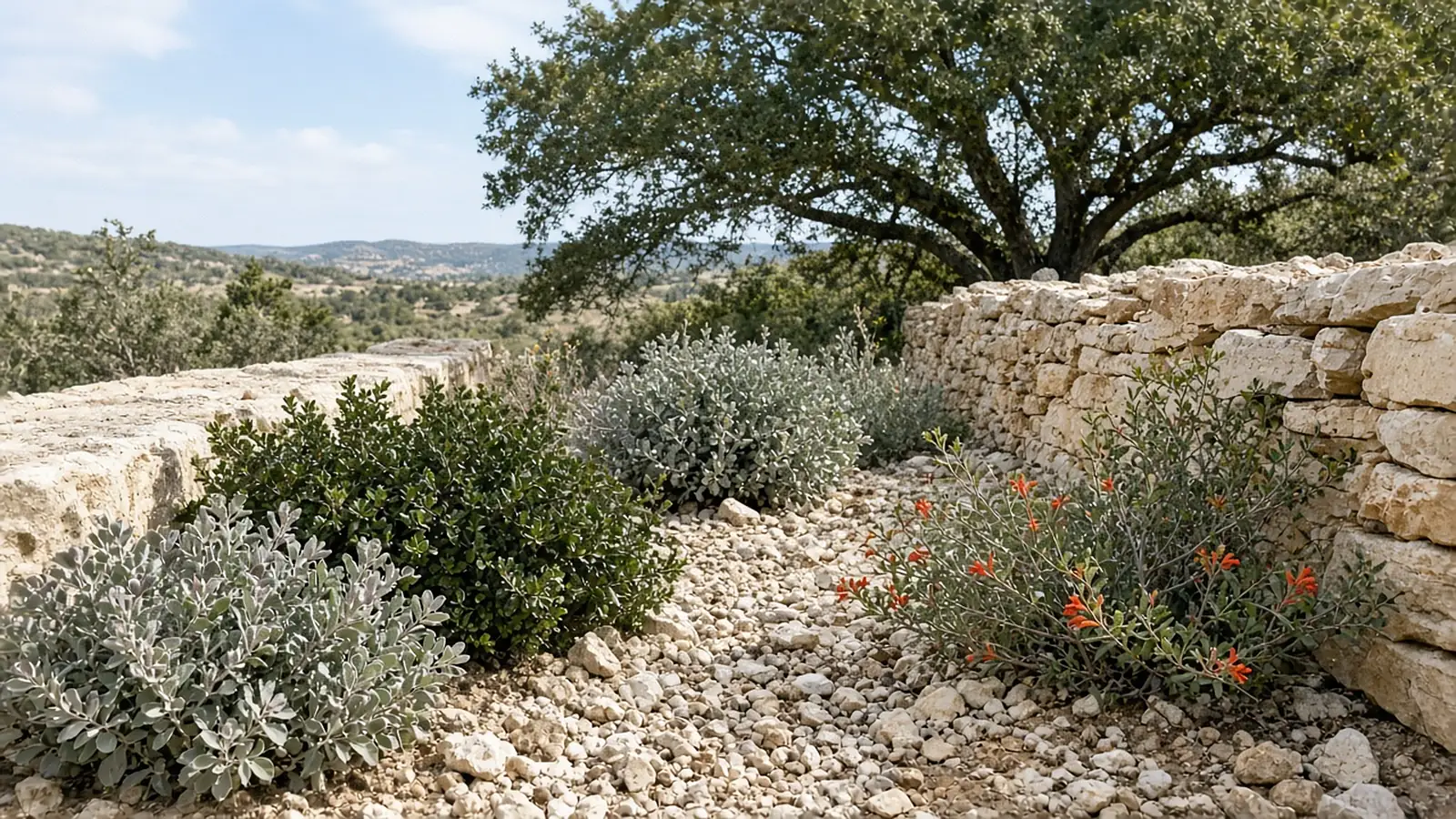
Top native shrubs for the Hill Country
These shrubs are documented either as native to the Edwards Plateau, Central Texas, or south-central Texas in the Lady Bird Johnson Wildflower Center’s plant database, and most also appear on a Texas A&M AgriLife Extension recommended-landscape list used in nearby Williamson County. This is not a ranked beauty contest and not a complete Hill Country flora. It is a first, sourced short list for a dry, limestone yard — written from Canyon Lake in Comal County (ZIP 78133).
The Wildflower Center also maintains a “Hill Country Horticulture” special collection of more than 430 species native to central Texas, which is the place to keep looking after this short list. [1]
How this list was chosen
Each featured plant has a Wildflower Center native-plant-database profile. Native distribution or habitat language on that profile was used to confirm a Central Texas, Edwards Plateau, or south-central Texas connection. Williamson County AgriLife’s 2009 recommended landscape-plant tables are used only as a supporting regional Extension list; that publication also includes non-native plants, which are not recommended here. [2] Nothing is included just because a nursery calls it “drought tolerant.”
At a glance
| Plant | Usual size (from the profile) | Light | Water use | Leaf habit | Deer resistance (Center’s term) |
|---|---|---|---|---|---|
| Cenizo, Leucophyllum frutescens | Typically 2–5 ft, occasionally to 10 ft | Sun or part shade | Low | Evergreen | High |
| Agarita, Mahonia trifoliolata | 3–6 ft, up to about 10 ft | Sun or part shade | Low | Evergreen | High |
| Texas mountain laurel, Dermatophyllum secundiflorum | Usually 10–15 ft; can exceed 30 ft | Sun or part shade | Low or medium | Evergreen | High |
| Yaupon, Ilex vomitoria | Usually no higher than 25 ft (range 12–45 ft) | Sun, part shade, or shade | Low | Evergreen | Moderate |
| Flame acanthus, Anisacanthus quadrifidus var. wrightii | Normally no more than 3 ft, can reach 5 ft | Sun or part shade | Low | Deciduous | High |
| Evergreen sumac, Rhus virens | Up to about 10 ft | Sun or part shade | Low | Evergreen (see note below) | Moderate |
Cenizo (Texas sage, Texas barometer bush)
Leucophyllum frutescens is a gray, usually compact shrub whose leaves are covered with silvery hairs. The Wildflower Center says it is typically 2–5 feet tall and occasionally reaches 10 feet, with a width of 4–6 feet, and that violet to purple (sometimes pink) flowers appear intermittently from spring to fall, often after summer showers — which is why it is called barometer bush. Native distribution in Texas includes the Rio Grande Plain, the southern Trans-Pecos, and the Edwards Plateau. [3]
Growing conditions on that profile: low water use; sun or part shade; dry soil moisture; rocky, well-drained soils, including limestone, sand, loam, clay, and caliche. The Center says cenizo is easy to grow so long as it has good drainage; it is susceptible to cotton root rot if the soil stays moist, and “cenizos should not be fertilized or over-watered.” Humidity and high night temperatures are described as lethal. During very cold winters it may lose a few leaves. The Center lists deer resistance as high, and says the plant can be sheared as a hedge. [3]
Maintenance notes from the same profile: the best time for planting most shrubs and trees is the dormant period of fall and winter; the first year requires regular deep watering for root establishment; once established, it does not require fertilization or watering beyond average rainfall. Tip-prune cultivated plants to keep them dense. [3]
Williamson County AgriLife lists “Ceniza/Texas Sage, Leucophyllum sp.” among recommended medium shrubs (6–9 feet in that table), with dusty gray evergreen foliage and bloom throughout summer. [2]
Agarita
Mahonia trifoliolata (also listed as Berberis trifoliolata) is a 3–6 foot evergreen, reaching 10 feet in favorable conditions, with rigid, spreading branches, holly-like trifoliate leaves ending in sharp spines, fragrant yellow flowers in February and March (the profile also lists April in the bloom-time field), and red berries from May to July. Native habitat is given as hills, open woods, rocky slopes and cliffs, from coastal South Texas northwest to the Trans-Pecos, on well-drained loam, clay, caliche, or limestone. Water use is low; light is sun or part shade. Deer resistance is high. Songbirds eat the fruit; quail and small mammals use the plant for cover. The fruit is described as edible and reputedly used for jelly and wine. [4]
The same Wildflower Center record includes a Digital Herbarium specimen collected 19 March 1995 in Comal County. [4]
Williamson County AgriLife lists agarita (Mahonia trifoliata in that table’s spelling) as a recommended medium shrub with holly-like evergreen foliage, yellow spring flowers, and red edible berries. [2]
Texas mountain laurel
Dermatophyllum secundiflorum (formerly Sophora secundiflora) is an evergreen, usually multi-trunked shrub or small tree. The Wildflower Center says its usual height at maturity is 10–15 feet, though it can be only a few feet tall or more than 30 feet. It has glossy, dark green compound leaves and showy, fragrant bluish-lavender flower clusters in February, March, and April. The fragrance is often compared to artificial grape products. It is drought-tolerant, prefers rocky limestone soil, and is native from central Texas west to New Mexico and south into Mexico. Like many woody plants native to rocky soils, it is slow growing. Calcium-carbonate tolerance is high; water use is low or medium; light is sun or part shade. Deer resistance is high. [5]
Poisonous seeds. The Center warns that the bright red seeds contain the highly poisonous alkaloid cytisine (also called sophorine), a substance related to nicotine and widely cited as a narcotic and hallucinogen. Treat the seeds as a hazard around children and pets, not as a snack or craft supply without that warning. [5]
The profile also warns against buying large, wild-dug, balled-and-burlapped plants: the species has a sparse root system with a deep taproot, and plants dug from the wild often go into shock and die. It is commercially available as a small to medium propagated plant. Seedlings grow slowly the first two years. [5]
Williamson County AgriLife lists Texas mountain laurel (Sophora secundiflora) as a recommended small tree or large shrub: a tree-like evergreen with purple spring flowers. [2]
Yaupon holly
Ilex vomitoria is a native evergreen shrub or small tree, usually no higher than 25 feet (the profile gives a range of 12–45 feet), with small dark green leaves and, on female plants, persistent red berries. Native distribution is described as southern Virginia south to Florida and west to southeast Oklahoma and central Texas. Water use is low; it will take sun, part shade, or shade; soils may be moist or well drained, including sandy, loamy, clay, limestone, or gravelly soils. The Center says it tolerates drought and poor drainage, with best red-fruit production when the shrub gets half a day of sun or more. You must have both a male and a female plant to have berries; nursery plants are typically female and propagated by cuttings. Deer resistance is moderate. It can be sheared into hedges or pruned into a tree shape. [6]
Williamson County AgriLife lists both yaupon holly and dwarf yaupon holly (Ilex vomitoria and I. vomitoria nana) among recommended plants. [2] An AgriLife horticulturist’s 2020 native-plant handout also lists yaupon and links the same Wildflower Center profile. [7]
Flame acanthus (hummingbird bush)
Anisacanthus quadrifidus var. wrightii is a spreading, usually 3-to-5-foot deciduous shrub (the size notes say it is normally no more than 3 feet tall but can reach 5 feet) with red-orange tubular flowers from June through October. The Wildflower Center says it is native from west and south-central Texas, including the southern Edwards Plateau, into northern Mexico, mostly on rocky, calcareous soils, but that it is adaptable to a wide variety of well-drained soils. Water use is low; light is sun or part shade; drought tolerance is high. It blooms best in full sun, and rain can trigger a flush of bloom. Flowers attract hummingbirds and butterflies. Deer resistance is high. [8]
Maintenance from that profile: prune in winter for more blooms and a compact shape. Where the top dies to the ground in winter, cut it back to the ground before spring; the plant can resprout from the ground like a perennial. It will seed out readily under favorable conditions. [8]
Williamson County AgriLife lists flame acanthus (Anisacanthus quadrifidus var.) as a recommended small shrub with orange flowers that attract hummingbirds and butterflies, noting that it reseeds easily and is deer resistant. [2]
Evergreen sumac
Rhus virens is a shrub or small tree from 6–10 feet, with shiny pinnate foliage, clusters of small greenish or white flowers in July and August, and red, fine-haired fruit in mid-September. The Wildflower Center says that in Texas it is found on rocky bluffs, slopes, banks, and dry hillsides in the Edwards Plateau and Trans-Pecos. Water use is low; light is sun or part shade; soil moisture is dry; drought tolerance is high. Deer resistance is moderate. Only female plants produce berries. The Center says it can make a thick hedge or screen, is generally insect- and disease-free, and is not a true evergreen in the strict sense: leaves stay green through the winter, then drop and are replaced within a week. [9]
Williamson County AgriLife lists evergreen sumac as a recommended medium shrub with glossy leaves that turn burgundy in the cool season and fuzzy orange/red berries. [2]
A cautious note on American beautyberry
American beautyberry (Callicarpa americana) is a native shrub with magenta-purple berry clusters, often 3–5 feet tall and sometimes up to 9 feet in favorable soil and moisture. It is included here with limits, not as a xeric limestone-slope plant. The Wildflower Center gives its native habitat as moist woods, thickets, wet slopes, bottomlands, and swamp edges, including Blackland woodlands; light requirement is part shade; soil moisture is moist; and the conditions comments say the shrub may temporarily defoliate and lose developing fruit during prolonged summer drought. Deer resistance is listed as “No,” and foliage is described as a favorite of white-tailed deer. [10]
Williamson County AgriLife lists it as a recommended small shrub but notes that it “prefers dependable moisture and deeper” soil (the line is cut off in the table). [2] In a Hill Country yard it is a better candidate for a moister, shadier understory than for a hot, unirrigated caliche bank.
When and how to plant
The most general planting-season statement in these profiles is on the cenizo page: the best time for planting most shrubs and trees is the dormant period of fall and winter, and the first year requires regular deep watering for successful root establishment. [3]
That first-year watering still has to obey your utility’s current stage. See Watering natives under local drought rules. Texas Water Company’s public Comal County page, checked 21 November 2026, said variance requests for new sod and/or landscaping will not be approved in Stages 2, 3, or 4. [11]
Once established, the repeated theme in these profiles is low water use and, for cenizo in particular, no fertilizer and no extra watering beyond average rainfall. [3] Overwatering a drainage-sensitive shrub is not a kindness.
Sources
- Lady Bird Johnson Wildflower Center, special collection “Hill Country Horticulture.” https://www.wildflower.org/collections/collection.php?collection=hch
- Texas A&M AgriLife Extension, Williamson County, 2009 Landscape Plants for Williamson County. https://williamson.agrilife.org/files/2014/08/2009_Recommended_Landscape_PlantsCounty_1.pdf
- Lady Bird Johnson Wildflower Center, Leucophyllum frutescens (cenizo). https://www.wildflower.org/plants/result.php?id_plant=LEFR3
- Lady Bird Johnson Wildflower Center, Mahonia trifoliolata (agarita). https://www.wildflower.org/plants/result.php?id_plant=MATR3
- Lady Bird Johnson Wildflower Center, Dermatophyllum secundiflorum (Texas mountain laurel). https://www.wildflower.org/plants/result.php?id_plant=DESE5
- Lady Bird Johnson Wildflower Center, Ilex vomitoria (yaupon). https://www.wildflower.org/plants/result.php?id_plant=ILVO
- Stephen Brueggerhoff, Texas A&M AgriLife Extension, Native Texas Plants for Home and Garden plant list, 17 June 2020. https://aggie-horticulture.tamu.edu/wp-content/uploads/2020/06/Native-Texas-Plants-for-Home-and-Garden-plant_list-1.pdf
- Lady Bird Johnson Wildflower Center, Anisacanthus quadrifidus var. wrightii (flame acanthus). https://www.wildflower.org/plants/result.php?id_plant=ANQUW
- Lady Bird Johnson Wildflower Center, Rhus virens (evergreen sumac). https://www.wildflower.org/plants/result.php?id_plant=RHVI3
- Lady Bird Johnson Wildflower Center, Callicarpa americana (American beautyberry). https://www.wildflower.org/plants/result.php?id_plant=CAAM2
- Texas Water Company, “Comal County Drought Conditions,” checked 21 November 2026. https://www.txwaterco.com/water-conservation/drought-management/comal-county-drought-conditions/